Special Contribution
The Future of Capitalism Will Be Led by Ame-no-Mioya-Gami
Why We Need an “Economy Backed by Virtue” Now
By HSU Vice Principal and Dean of Faculty of Human Happiness, Hakuun Kurokawa

(From HSU Campus Newspaper Angel's Ladder Issue 120)
As a result of prioritizing the pursuit of profits, modern capitalism has caused various problems, including the accelerated money game and the decline of the real economy (manufacturing of goods and values), as well as all kinds of deadlocks and economic stagnation. Amidst all this, we must go back to the original concept of economy. The philosophy of Japanese Father God Ame-no-Mioya-Gami, which has been passed down in an ancient Japanese document Hotsuma Tsutae, contains teachings on how to attain economic success that is accompanied by virtue.
“Working without relying on help”
—The spirit of hardworking supports the foundation of a country
The first point we must focus on is how much Ame-no-Mioya-Gami emphasized the spirit of labor. In aya 13 (chapter 13) of Hotsuma Tsutae, it says, “Those who do not work even when they have been given life in this world and simply live life like a dog begging for the fruits of other people’s labor are committing a sin in the eyes of heaven.”
Furthermore, in aya 16 it says, “Even if people work in extremely harsh conditions and work themselves to the bone, as long as they are open-minded and positive, life energy will spring forth and they will be blessed with plenty of children.”
This teaching emphasizes the virtue of hard work, in other words, the importance of putting yourself to work instead of depending on the help of others. It also serves as a warning to New Welfarism that exceedingly demands government support in the modern age.
Wealth is something that is temporarily in your care
—An investment for the future
The next point that Hotsuma Tsutae makes is about the essence of saving and investing. In aya 13, it teaches: “Wealth that is merely accumulated is valueless like dust and litter. You must use it for the people of the future.”
The underlying idea here is that wealth is something that is temporarily placed in your care. Therefore, wealthy people are not proprietors of wealth but managers of wealth. Their mission lies in investing in education, technology, and the public good to nurture the coming generation. This idea suggests healthy capitalism (a virtuous investment of wealth).
The spirit of nagasaki
—A society of virtuous leaders
An even more crucial point is the principle of governance that suggests a society of virtuous leaders. According to Hotsuma Tsutae, leaders must have the spirit of nagasaki, which means “put you ahead of me,” and be a guide for the people they lead. Furthermore, the people are referred to as aohitokusa and are considered a holy existence called wakemitama, or a split soul of Ame-no-Mioya-Gami. This fact shows the true foundation of leadership based not on power and control but on virtue.
Japanese Capitalism was fully completed with Ninomiya Sontoku and his teachings
These teachings of Ame-no-Mioya-Gami on hard work, distribution of excess wealth (investment for the future), and virtue that are indicated in Hotsuma Tsutae have continued to flow in the depths of Japanese society and have developed into a complete form in the early modern period as Ninomiya Sontoku's Hotoku Philosophy. This philosophy teaches that “economic activity without morality is a sin, and morality without economic activity is nonsense.” This is the perfect modern representation of the ideas described in Hotsuma Tsutae. In other words, the unification of virtue and wealth is the essence of Japanese Capitalism.
The teachings of Ame-no-Mioya-Gami resonate with Buddhism
It is worth pointing out that these teachings resonate deeply with Buddhism. The idea that humans are souls that have split from Ame-no-Mioya-Gami is the same as the Buddhist concept of Buddha-nature that dwells in humans. The perspective on spiritual discipline that encourages you to restrain your desires (shii) and let your true self (tama) shine. The philosophy of governance based on mercy that lies in the idea of Chakravarti. These overlapping ideas are not a coincidence. From a spiritual perspective, the teachings of Lord El Cantare were preached by Ame-no-Mioya-Gami in Japan, but over time, they became a shell of what they used to be as faith in ethnic gods spread. That is why Ame-no-Miyoya-Gami's teachings were reintroduced to Japan through Shakyamuni Buddha.
An “economy backed by virtue” will change the world
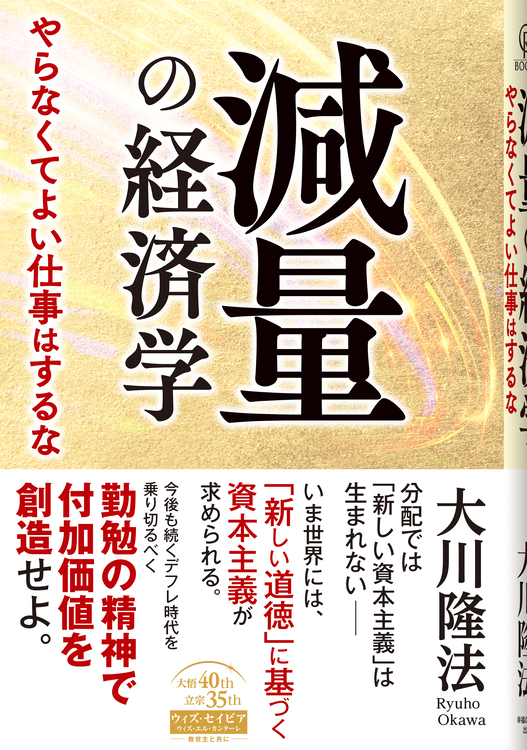
From Chapter Two, “Ame-no-Mioya-Gami’s Economics” of the book, The Economics of Reduction, it says, “Those who have the capacity to generate wealth must also be able to guide people in the moral sense. Society must operate in a world where education, morals, and customs nurture such people.” Right now, based on “Ame-no-Mioya-Gami’s Economics”, Japan is not only expected to rebuild its economy but also to become a world leader that can realize an economy backed by virtue. We are now standing at this turning point in history.

