【Special Feature】
Ame-no-Mioya-Gami, the God Deleted from Kojiki and Nihon Shoki
—Bringing back the true perspective of Japanese faith and history
By Professor of the Faculty of Human Happiness at Happy Science University, Kazuyuki Kaneko

(From HSU Campus Newspaper Angel's Ladder Issue 118)
Master Ryuho Okawa's spiritual research gave us the opportunity to unravel the true history of Japan. We are discovering that Japanese history has lasted not 3,000 years but 30,000 years and that there was an advanced civilization called “Fuji Dynasty” centered on Mount Fuji. It all started with the descent of Ame-no-Mioya-Gami, a Space God and the Creator God of Japan. In this article, we will investigate the meaning of revealing the existence and the teachings of the true origin of Japanese Shinto, Ame-no-Mioya-Gami.
The problems of Shinto according to Aston
In the preface of the book, Shinto (The Way of the Gods) by William George Aston, he astutely points out the characteristics of Shinto that makes it an unquestionably underdeveloped religion in comparison with other world religions (the following is a summary by Kaneko).[1]
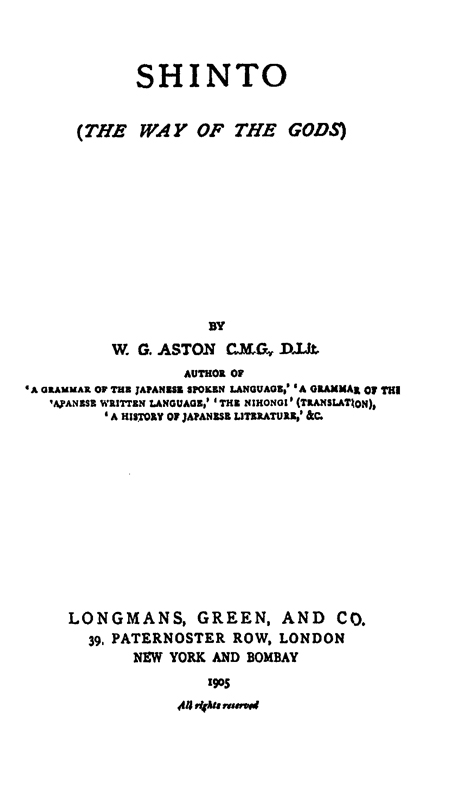
(EBOOK)
1. Lack of Supreme Deity
2. Absence of images and of a moral code
3. Feeble personifications of the concept of spirit
4. Practical non-recognition of a future state
5. Absence of a deep, earnest faith
This was his conclusion. He had a keen eye. On the other hand, the two books Kojiki and Nihon Shoki (together known as Kiki), which he likely based his research on to write his book, say nothing about the conditions that make a religion world-scale. In other words, there is a possibility that something that originally used to exist could have been removed for some purpose.
The teachings of and faith in Ame-no-Mioya-Gami that originally existed
Researchers commonly agree that there are hardly any teachings or ideologies in Kiki. However, a book called Hotsuma Tsutae, which was written in an earlier time, included advanced teachings that talk about the existence of the Supreme God, the macroscopic view of the universe, and the spiritual view of life, which Aston points out in his book.
The first characteristic of Hotsuma Tsutae is that it clearly teaches the macroscopic view of the universe and the essence of human beings. For example, Hotsuma Tsutae talks about the center of the universe called amoto and a galaxy of stars called muraboshi. It even refers to Earth as kunitama, which implies that Earth was recognized as a sphere (in Japanese, kuni means "land" and tama means "ball" or "sphere"). The recognition of Earth as a sphere is known to have begun with the philosophers of ancient Greece back in sixth century BC, but Hotsuma Tsutae significantly predated that, which is quite astonishing.
This ancient Japanese document teaches that we, human beings, are all souls who have split from Ame-no-Mioya-Gami and that our soul and body undergo training on earth as one entity before splitting again upon death. It also teaches that our destination in the afterlife depends on how much we polished our mind—those who have a pure mind return to heaven and are reborn in this world as a human, whereas those who lived greedily and lacked consideration for others go to the “lost world” and may be reborn as a beast. To put it another way, Hotsuma Tsutae contains advanced teachings that is in line with Buddhist concepts of karma and reincarnation.
Second, the document shows that the rulers and the people of ancient Japan were full of reverence and gratitude toward Ame-no-Mioya-Gami. This means that one of the conditions of a world religion that Aston pointed out (5. General absence of a deep, earnest faith) actually existed in Japan. The people of ancient Japan had a pure and earnest faith toward the Creator God.
Hotsuma Tsutae teaches that “All life, without exception, is a gift left by Ame-no-Mioya-Gami for each of them to look after”[2], so the people of ancient times were constantly aware that they themselves were creations of Ame-no-Mioya-Gami, who created the universe, and were always grateful for the life they were given.
On a related note, one researcher points out the unnatural nature of Kiki as they do not mention Mount Fuji at all[3]. Spiritual readings conducted by Happy Science have revealed that the Fuji Dynasty, which was started by Ame-no-Mioya-Gami at the foot of Mount Fuji, existed in three periods[4]. Thus, Mount Fuji is an important symbol of the faith in Ame-no-Mioya-Gami.
The Japanese faith and history without Ame-no-Mioya-Gami is an “evil view”
Multiple researchers of Japanese history have pointed out that Hotsuma Tsutae is the original work on which Kiki was based.
For example, the preface to Kojiki mentions the Woshite literature[5], and O-no-Yasumaro, who was involved in the compilation of Kojiki under the direction of Empress Genmei, mentions in the preface that he thoroughly researched and selected information from the Woshite literature[6]. Additionally, given that the ruler at the time burnt books that contradicted the ruler's views[7], there is more than enough reason to believe that although Kojiki was based on Woshite literature, it was deliberately edited and falsified.
The major falsification was the replacement of Ame-no-Mioya-Gami faith with faith in a goddess called Amaterasu. The most convincing reason for this is that the empress at the time did so to legitimize female rule. However, according to Hotsuma Tsutae, the aforementioned “goddess” did not exist. Therefore, this faith and history that deleted Ame-no-Mioya-Gami, the most important Creator God of Japan, was built upon fiction invented by some human beings as a story that was convenient for them. This is clearly an “evil view,” which is one of the wrong views taught in Buddhism.
Mr. Shoichi Watanabe states that the national polity of Japan changed five times since Emperor Yomei converted to Buddhism[8]. However, introducing Ame-no-Mioya-Gami faith, which is being revealed now, is much bigger than just a change in national polity. “What is about to happen is the second founding of a country”[9] and is a paradigm shift, or a change in fundamental thinking, to reconstruct Japanese history.
Just as Master Ryuho Okawa states, “As the question of whether a century of prosperity will come or not is related to how we view history”[10]. To open up the bright future of Japan, we must disclose the true faith and history of Japan.
References
- W.G. Aston, Shinto (The Way of the Gods) (EBOOK)
- Toshio Imamura, Hajimete no Hotsuma Tsutae—Chi no Maki
- Munemoto Kobukata, Yomikurabe Kojiki to Hotsuma Tsutae
- Ryuho Okawa, A Spiritual Message from Konohana-no-Sakuya-Bime
- Mitsuru Ikeda, Hotsuma Nihon no Rekishi Monogatari 2
- Translated by Takehiko Fukunaga, Gendaigoyaku Kojiki
- Itokyou, Shinjitsu no Hotsuma Tsutae wo Motomete
- Shoichi Watanabe, Bunka no Jidai
- Ryuho Okawa, Dynamite Thinking
- Ryuho Okawa, The Laws of Miracle

